

Australia is heading into what could be one of the most intense summers in recent memory.
After an El Niño event, a classification by certified organisations for when ocean surfaces in the tropical Pacific are warmer than usual, Australia's climate becomes more sensitive to extreme weather conditions. In some parts of the world, the warming sea causes water to evaporate, rise with air pressure, form rain clouds, and drench countries in heavy rain and floods. In other parts of the world, like Australia, where the storms track and pull moisture away, countries are at highest risk for heatwaves, bushfires, and drought.
What We Can Expect
If you were anywhere near Western Sydney in January 2020, you will not have forgotten what heat feels like. Penrith hit 48.9 degrees and was recorded as the hottest place on Earth that day. Streets emptied. Air conditioners ran flat out. And even after the sun went down, the heat lingered well into the night.
The Bureau of Meteorology (BoM) declared El Niño conditions active from 1 July 2026, with forecasts pointing to a "strong to very strong" event. Some experts warning Australians of what is coming have nicknamed this year's event "Godzilla El Niño".
BoM has released an official long-range forecast for July to September on their website, but has said it is too early to say what summer will look like. However, hotter days are certain: daytime and overnight.
There is a lot of time to plan, so there is no need to panic. Understanding what is coming and what you can do to prepare your home is the best way to stay comfortable, cool, energy efficient and keep your family safe.
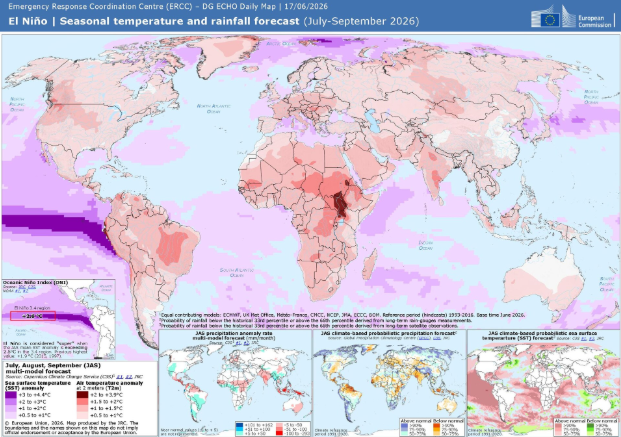
El Niño Seasonal Temperature & Rainfall Forecast (July–September 2026) — Source: ERCC / European Commission
What is El Niño?
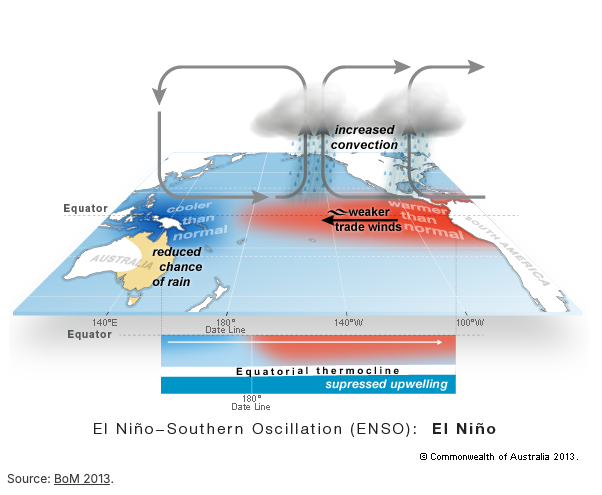
El Niño is a naturally occurring climate pattern linked to the warming of sea surface temperatures in the central and eastern tropical Pacific Ocean. It is one phase of the El Niño-Southern Oscillation (ENSO) cycle, the other being La Niña, which brings cooler than average Pacific waters.
Source: Bureau of Meteorology, 2013.
Where Does El Niño Fit in the Bigger Picture?
To understand El Niño, it helps to understand the system it belongs to: the El Niño-Southern Oscillation, or ENSO. ENSO describes a recurring, natural cycle in the tropical Pacific Ocean that swings between three phases: El Niño, La Niña, and Neutral. Each phase influences temperature, rainfall and wind patterns across the globe, and Australia sits squarely in its path.
In a Neutral year, the tropical Pacific sits close to its long-run average temperature. Conditions over Australia tend to reflect more typical seasonal patterns, with no strong push toward either unusual dryness or unusual rainfall.
La Niña is the cooler phase. Sea surface temperatures in the central and eastern Pacific drop below average, and the knock-on effect for Australia is typically above-average rainfall, cooler days in the south and east, elevated flood and cyclone risk, and lower bushfire danger. La Niña events in 2010–11 and 2021–22 were responsible for the widespread flooding that devastated large parts of Queensland and New South Wales.
El Niño is the warm phase, and the one that concerns Australia most heading into summer. Sea surface temperatures in the central and eastern Pacific climb above average, disrupting the trade winds and moisture patterns Australia normally relies on. The result is below-average rainfall, warmer days, higher bushfire risk, and longer heatwaves.
In plain terms: when the Pacific runs hot, Australia runs dry.
Are Dry Conditions Already Arriving?
For some parts of the country, a shift toward drier weather has already begun. El Niño is one contributing factor, alongside the Indian Ocean Dipole, regional sea temperatures, and longer-term climate trends. It is not a single cause and effect relationship.
According to the Bureau of Meteorology, since January 2026 it has been drier than average across:
- North-eastern New South Wales into southern Queensland
- Southern Victoria
- Western and northern Tasmania
- Parts of Western Australia, including the south-western corner
For homeowners, an extended dry period has some practical implications beyond the garden. Dry soil can shift and shrink, affecting drainage around the home. Water restrictions become more likely in some areas. And a dry landscape absorbs and radiates more heat, adding to the cooling challenge inside your home during hot spells.
Where Is the Impact Likely to Be Most Noticeable?
El Niño affects different parts of Australia in different ways, and outcomes vary from event to event.
Western Sydney
Western Sydney is structurally more exposed to heat than most other parts of the country. The combination of rapid urban development, large areas of hard surface, and lower tree canopy cover means temperatures in suburbs like Penrith, Campbelltown, Parramatta, and Blacktown regularly run 8 to 10 degrees above the coast on the same day. El Niño conditions tend to extend and intensify that pattern.
A project led by Dr Laura Fernandez at Macquarie University, in collaboration with Sydney Water and the Botanic Gardens of Sydney, has spent three years monitoring 600 trees across 15 species at the Australian Botanic Garden Mount Annan, testing whether recycled water can support urban tree growth during dry periods. The early results are encouraging. "Recycled water is not having a negative impact on soil salinity or on tree growth, and the growing urban forest is reducing ambient temperature," Dr Fernandez says.
Southeast Queensland
Southeast Queensland, from Brisbane through to the Gold Coast hinterland and inland toward Toowoomba and Roma, has been tracking below-average rainfall since the start of 2026. Fire authorities have been conducting preparatory reduction burns since April, which is standard practice ahead of a drier season.
Regional Western Australia
Western Australia's south-west corner has already been recording below-average rainfall in 2026. Inland areas including Kalgoorlie, Merredin, and Geraldton regularly experience intense heat over multiple consecutive days in summer. Perth's outer suburbs, particularly those developing eastward, face similar conditions to Western Sydney in terms of heat retention and limited natural shade.
A Capital City Snapshot
Heat is experienced differently depending on local climate, housing stock, and what a population is acclimatised to. Here is a practical overview of what each capital city can expect.
| City | Typical Summer Range | Points to Watch |
|---|---|---|
| Sydney | Coastal/eastern suburbs: mid-to-high 20s. Western suburbs: low-to-mid 40s during heatwaves, up to 48.9°C recorded at Penrith in January 2020 | Western suburbs run up to 10°C hotter than the coast during extreme events. Overnight temperatures frequently remain above 25°C, preventing physiological recovery |
| Melbourne | Average maximum around 26–27°C, with 40°C+ days during heatwaves | Rapid northerly winds ahead of cold fronts can push temperatures sharply higher in hours. All-time CBD record stands at 46.4°C (February 2009) |
| Brisbane | Low-to-mid 30s, with humidity a compounding factor on heat perception | El Niño years bring decreased cloud cover and warmer-than-average daytime temperatures. High humidity raises apparent temperature beyond what the thermometer reflects |
| Perth | Average around 31–32°C, with low 40s possible during heatwaves | Western Australia recorded its warmest summer on record in 2023–24. Multi-day events with warm nights affect vulnerable residents |
| Adelaide | Upper 30s to low 40s during heatwaves, with 42.7°C recorded in February 2025 | Multi-day heatwaves strain the grid as evening air conditioning demand peaks after solar generation drops off |
| Hobart | Average maximum around 21–23°C, with heatwaves capable of exceeding 30°C | Population and housing stock are less adapted to heat. Moderate temperatures can carry outsized health risk relative to cities further north |
| Canberra | Average maximum around 28–29°C, capable of spiking into the high 30s to low 40s | Inland continental location means no coastal moderation. Low humidity keeps apparent temperature lower but does not reduce physiological risk at extremes |
What High Heat Means for Your Energy Bills and the Grid
The health case for air conditioning during a heatwave is straightforward. For older Australians, young children, and anyone with a heart or respiratory condition, sustained indoor heat is a genuine medical risk, not just discomfort. The practical challenge is that everyone reaches for their air conditioner at the same time.
When temperatures climb across multiple days, cooling demand across the network rises sharply. Air conditioners, pool pumps, and refrigeration systems all draw more heavily as they work harder against the heat, simultaneously across millions of households. The result is a concentrated, sustained surge in electricity demand at exactly the moment the grid is already under its greatest stress.
How the Grid Responds to Heat
Australia's eastern states are connected through a shared electricity network, which means a state running short on supply can, in normal conditions, draw on generation from a neighbouring state. The problem is that heatwaves do not always stay in one place. When South Australia and Victoria experience extreme heat simultaneously, both states are drawing harder on the network at the same time. The buffer between them shrinks.
In those conditions, the Australian Energy Market Operator has two tools available: calling on emergency reserves, and, as a last resort, directing sections of the network to switch off in rotation, commonly known as rolling blackouts. During the January 2020 heatwave, with multiple states affected simultaneously, AEMO activated emergency reserves to manage the shortfall.
What Happens to Electricity Prices
During the January 2019 heatwave, wholesale electricity prices in South Australia averaged around $308 per megawatt-hour across the event, compared to an annual average of roughly $85 per megawatt-hour. That is a price increase of more than 260% during peak summer conditions. In February 2017, prices in New South Wales reached $14,000 per megawatt-hour during a heatwave, against an average of $100–200 per MWh.
For most households on fixed-rate retail contracts, short-term wholesale spikes do not show up directly on your bill. But they flow through to retail pricing over time, and households on variable or time-of-use tariffs can see the impact more immediately.
Running the Air Conditioner Without Running Up the Bill
The most effective way to reduce air conditioning costs during a heatwave is to reduce the load on the system, not just the thermostat setting. A home that is keeping heat out through insulation, shading, and draught sealing requires less cooling to maintain a comfortable temperature.
If your household is on a time-of-use tariff, cooling the home aggressively in the mid-morning, before peak pricing kicks in late afternoon, and then maintaining temperature rather than recovering from heat is a more cost-effective approach than waiting until 4pm to switch the system on.
For households with solar and a battery, this is exactly the scenario a well-designed system is built for. Generation is strong during the hottest, sunniest part of the day. A battery stores what the household does not immediately use and can discharge it through the late afternoon and evening peak, when grid power is most expensive and cooling demand is highest.
Why a Home Battery Is Worth Considering This Summer
The grid pressures outlined above are not hypothetical. They are already shaping how households across the country experience summer. And for most homeowners, the smartest move is not to sit tight and hope the network copes, but to simply need it less.
Protection When the Grid Goes Down
When speaking with an installer, ask directly: does this system include blackout protection, which circuits does it cover, and for how long can it sustain them under a realistic summer load?
A Buffer Against Peak Tariffs and Demand Charges
For households and small businesses on demand tariffs, the financial case for battery storage goes beyond avoiding high prices at peak time. Demand tariffs charge based on your highest point of consumption during a billing period. A battery that supplies stored energy during that window directly reduces what you are billed for, meaning you can run your air conditioning when you need it without rationing comfort.
Current Government Incentives Are Making Batteries More Accessible
Cheaper Home Batteries Program: The Australian Government's Cheaper Home Batteries Program provides an upfront subsidy on eligible home battery installations. Eligibility and subsidy levels vary, so confirm the current details with a registered installer or through the government's energy website.
Small-scale Technology Certificates (STCs) for Solar Panels: If you are adding solar panels as part of a new system, the federal Small-scale Renewable Energy Scheme provides a financial incentive in the form of STCs, typically applied as a point-of-sale discount. The value of STCs reduces each year as the scheme steps down toward its 2030 end date.
Interest-Free Energy Upgrades Loan (NSW): For New South Wales households, the state government offers an interest-free loan for eligible energy efficiency upgrades, including solar panels, battery systems and insulation. If you are outside New South Wales, check your state government's energy website for equivalent programs.
South Australians Particularly Need to Be Blackout Ready
South Australia is facing a specific, quantified capacity shortfall this summer. AEMO has forecast a reliability gap in South Australia of 390MW for 2026–27, linked to the scheduled retirement of the Torrens Island B Power Station. Adelaide heads into this El Niño summer with less generation buffer than it has had in previous years, right as heatwave-driven demand is expected to climb.
Even if the Torrens Island B extension proceeds, Adelaide does not head into this summer with unlimited spare capacity. During the January 2019 heatwave, Adelaide recorded 46.6°C on 24 January 2019, breaking its previous all-time record of 46.1°C. An infrastructure failure at the Fulham Gardens substation left nearly 20,000 inner-city homes without power overnight as a separate network event.
Adelaide is not the only city under pressure, but it is the one with the most specific, quantified warning attached to it heading into this summer. If you are in Adelaide, or anywhere relying on the same interconnected grid, now is the time to think seriously about backup power.
How Home Solar and Batteries Are Already Strengthening the Grid
Australia has spent the better part of a decade building one of the most solar-dense electricity systems in the world, and the results are already showing up in the data. The grid is not the same grid it was during the 2019 heatwave. It has been quietly, substantially rebuilt from the rooftop down.
AEMO CEO Daniel Westerman pointed to 27 January in Victoria, a day on which temperatures hit 43°C and underlying power demand smashed the record, as a case in point. The day was barely noticed by the market operator because of the combined effect of home batteries, virtual power plants and grid-scale storage absorbing and redistributing the load. A day that would have been a crisis event a few years ago passed without incident.
Other Ways You Can Prepare
- Check and improve your insulation. Roughly 80% of Australian homes carry an energy efficiency rating of two stars or less out of ten. An uninsulated ceiling space can reach temperatures above 60 degrees on a hot day. Ceiling insulation with an R-value of at least 4.1 is one of the most impactful single upgrades available. CSIRO research indicates ceiling insulation can reduce heating and cooling costs by up to 45%. Draught sealing around doors, windows, and exhaust fans is inexpensive and makes a noticeable difference.
- Plan for water. In areas already tracking dry, water restrictions are a possibility later in the year. Checking your rainwater tank and topping up mulch around garden beds now helps protect soil moisture. If you are in a rural area relying on an electric pump for tank or bore water, have a backup plan for a power interruption during a hot period.
- Service your cooling system. Booking a service for your air conditioner before spring, while technicians are readily available, is one of the most straightforward things you can do. A well-maintained system runs more efficiently and is less likely to fail at an inconvenient moment. Check the filters and confirm the unit is appropriately sized for the spaces you are cooling.
- Understand your solar and battery system. El Niño's reduced cloud cover is actually good news for solar generation. Clear, sunny days mean your panels produce well during exactly the period you need cooling most. Two things are worth understanding: battery placement and thermal management matter (lithium-ion batteries perform best between 10 and 30 degrees), and a charged battery does not automatically protect you during a grid outage without dedicated blackout protection hardware.
- Have a simple plan for disruptions. Sign up for outage alerts from your local distributor. Identify a cool public space as a fallback if home cooling fails. Keep a charged power bank and torch accessible. Check on elderly neighbours during prolonged heat. Know the signs of heat stress and heat exhaustion in children and older family members.
Now Is the Time to Prepare
If you are concerned about energy demands for this El Niño period, or for the forecasted higher temperatures expected in 2027, now is a great time to create your plan of action:
- Do you have a plan for power backup in case of a blackout?
- Do you have a plan for a buffer from the main grid during peak energy demands?
- Do you have a plan to keep the home cool, especially for warmer afternoons and nights?
Solar Battery Group can assist you with a personalised solution that factors in your current energy needs and some extra buffer to cover air conditioning and other cooling costs. Home batteries are already helping homeowners reduce the thermal impact of climate change. By installing a solar battery, you are doing more than safeguarding your comfort and protecting your family. You are contributing to a cleaner and more secure energy future for everyone.
Frequently Asked Questions
What is El Niño and how does it affect Australia?
El Niño is a naturally occurring climate pattern where sea surface temperatures in the central and eastern tropical Pacific Ocean warm above average. For Australia, this typically means below-average rainfall, warmer days, higher bushfire risk, and longer heatwaves. The Bureau of Meteorology declared El Niño conditions active from 1 July 2026, with forecasts pointing to a strong to very strong event.
Will my electricity bills go up during a heatwave?
For most households on fixed-rate retail contracts, short-term wholesale price spikes do not show up directly on your bill. However, those on variable or time-of-use tariffs can see the impact more immediately. Running air conditioning through a three-day heatwave during a price spike costs noticeably more than running it on a mild autumn afternoon. A home battery storing daytime solar generation and discharging it during the peak evening window is the most effective way to reduce that cost.
Will my solar battery protect me during a blackout?
Not automatically. A standard grid-connected system, even with a fully charged battery, will shut down when the grid goes offline. This is a safety requirement to protect utility workers. For blackout protection to work, your system needs dedicated hardware that can isolate your home from the grid and run selected circuits independently. Ask your installer directly whether blackout protection is included, which circuits it covers, and for how long it can sustain them.
Why is South Australia at particular risk this summer?
AEMO has forecast a reliability gap in South Australia of 390MW for 2026–27, linked to the scheduled retirement of the Torrens Island B Power Station. This means Adelaide heads into this El Niño summer with less generation buffer than in previous years, right as heatwave-driven demand is expected to climb. An in-principle agreement to extend Torrens Island B by two years may address the gap, but the situation remains live. Check AEMO's current Electricity Statement of Opportunities for the latest status.
What government incentives are available for home batteries?
The Australian Government's Cheaper Home Batteries Program provides an upfront subsidy on eligible home battery installations. NSW households can access an interest-free loan for energy efficiency upgrades including batteries. The federal Small-scale Technology Certificates (STCs) scheme provides a point-of-sale discount on solar panels. Check with a registered installer or your state government's energy website for current eligibility and subsidy levels.
Does El Niño affect solar panel performance?
El Niño's reduced cloud cover is actually good news for solar generation. Clear, sunny days during the hottest period of the year mean panels produce well during exactly the time you need cooling most. However, very high temperatures can marginally reduce panel efficiency, and battery thermal management matters: lithium-ion batteries perform best in a temperature range of roughly 10 to 30 degrees, so placement and ventilation are important considerations.