

If you've been putting off getting a battery because the rebate process looks like a maze of government jargon, you're not alone.
Homeowners ask us some version of the same question every week: "I want the discount but how do I actually sort it out?"
The short answer: if you go through a properly accredited installer, you never touch the paperwork yourself, you never deal with the government directly, and you never wait for a reimbursement. Here's exactly how that works, and what to check before you sign with anyone.
What is the Cheaper Home Batteries Program?
The Cheaper Home Batteries Program is the federal government scheme that has been running since 1 July 2025. It gives Australian households, small businesses and community organisations a discount of around 30% on the upfront cost of installing an eligible small-scale battery system, between 5 kWh and 100 kWh in nominal capacity.
The program's settings changed on 1 May 2026, adjusting how the discount scales with battery size. The core eligibility rules, size range, the requirement for solar pairing, and VPP capability, did not change. Because these settings can be updated again, we recommend confirming current figures directly with us or with the Clean Energy Regulator before you sign anything.
This isn't a rebate you claim after the fact. It's delivered through Small-scale Technology Certificates (STCs), a form of tradeable, government-backed certificate tied to your battery's usable capacity. Someone has to register your system, create those certificates, and sell them to recover their value. That's a genuine, multi-week regulatory process, and it's not something most homeowners have any interest in running themselves. That's why we run it for you.
How we take the rebate process off your plate
This is the single biggest reason to go through an accredited installer rather than trying to navigate this yourself.
We track the rules so you don't have to
Rebate schemes change. The 1 May 2026 update to how STC values scale with battery size is a good example, if you weren't watching for it, you wouldn't know your numbers had shifted. Our team monitors the Clean Energy Regulator's requirements and the Clean Energy Council's approved product list on an ongoing basis, because our accreditation depends on it. When the rules move, we move with them, and we build the current settings into your quote rather than relying on out-of-date figures.
We calculate your eligibility and entitlement before you sign anything
Before we install anything, we assess:
- Your existing solar setup, or design a new one if you don't have solar yet
- The exact battery and inverter combination that suits your home, checked against the CEC's current approved product list
- How many STCs your system's usable capacity generates (only the first 50 kWh of usable capacity is eligible, regardless of nominal size, so getting this right matters)
- Whether your inverter meets the VPP-capability requirement for grid-connected systems
Getting the usable-capacity calculation wrong, or installing gear that isn't on the approved list, can mean losing the rebate entirely after the money's already been spent. We do this assessment as standard, as part of your quote, at no extra cost.
Your quoted price already has the discount built in
This is the part that saves you the most stress. Once we've worked out your entitlement, we build it into your upfront quote. The price you're shown, and the price you pay, already has the government's contribution taken out. You're not paying full price and waiting on a reimbursement.
To make this happen, you assign us the right to create and sell the STCs associated with your system, in exchange for that upfront discount. This is a standard, government-recognised mechanism used by the majority of Australian households to access this rebate. The specific terms are set out in your contract and assignment paperwork. We'd encourage you to read that documentation carefully and ask us any questions before signing.
We manage certificate creation, including deadlines and evidence requirements
Once your system is installed, here's what's actually involved:
- Certificates must be created in the REC Registry within 12 months of the installation date. Miss that window and the entitlement is lost.
- Documentation must be gathered and correctly signed off, including declarations from the installer, designer, retailer and owner, plus time, date and geolocation-stamped site photos, and serial number photos of the equipment installed.
- If you tried to do this yourself, you would need to set up a "registered person" account with the Clean Energy Regulator. That verification process can take six weeks or longer.
- As a registered agent, we already hold the appropriate account type and established processes to submit this correctly the first time.
- The Clean Energy Regulator can request supporting documents for up to five years after a certificate is created. We keep proper records so that never becomes your problem.
None of this is paperwork you'll ever see. It happens on our side.
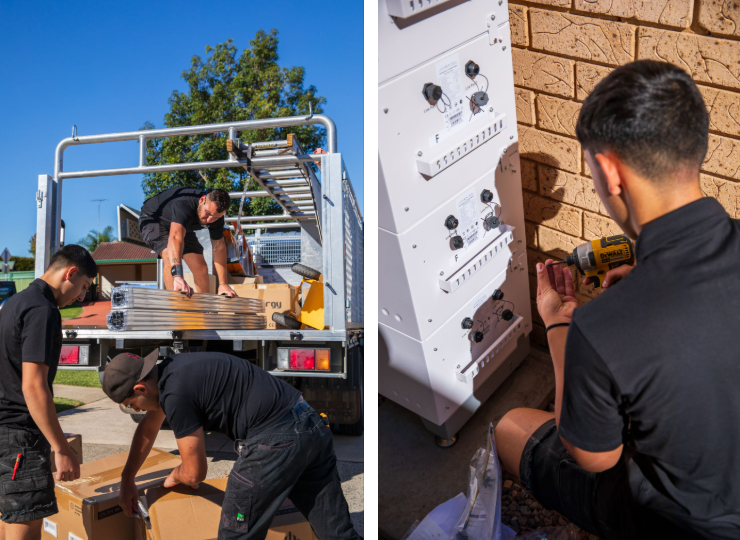
How STCs get sold, and why it matters that we carry the risk
This step is worth explaining properly, because people often don't realise it exists. STCs aren't cash. They're tradeable certificates whose value moves with the STC market. Once created, someone still has to sell them.
Assign to an agent
The agent handles the paperwork and pays out on their own stated timeframe once documentation is submitted. This is what we do for you.
Open market
Negotiating directly with STC buyers or brokers through the REC Registry. Can settle quickly, but requires you to find a buyer and manage the trade yourself.
STC Clearing House
Government-run, fixed price of $40 per certificate. No guaranteed timeframe. Certificates sit in a first-in-first-out queue and can take days to months to sell.
If you went it alone, you'd be choosing between speed and certainty, and either way, you'd carry the financial risk while your certificates sit unsold. When you assign your STCs to Solar Battery Group at installation, that uncertainty doesn't touch you. You've already received your discount upfront. Whatever happens in the STC market after that point is our risk and our administrative burden, not yours.
We manage the ongoing compliance obligations
The retailer, designer and installer are each required to provide written statements to the Clean Energy Regulator confirming the system is safe and compliant. We manage these submissions internally, along with the photographic and documentary evidence the Regulator can audit for years afterward.
Here's what you'd be signing up for
Setting up your own Regulator account (weeks of identity verification), calculating your own certificate entitlement, assembling and signing the correct documentation, creating the certificates within the 12-month deadline, then finding a way to sell them, either fast and dependent on finding a buyer yourself, or slower and guaranteed through the Clearing House.
Going through Solar Battery Group replaces all of that with a single upfront price, already discounted. We take on the compliance work, the certificate creation, the sale and the waiting period. The rebate happens in the background, on our side of the transaction, while you get a properly installed battery at a lower net cost.
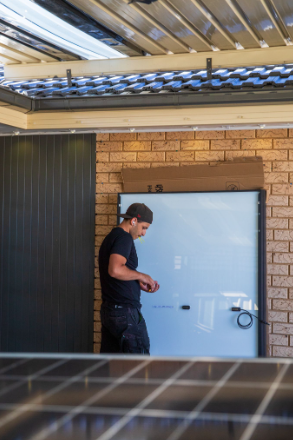
Why your choice of installer determines whether you're eligible at all
This is the eligibility gate that makes everything above possible in the first place.
The installation must be carried out by, or supervised on-site by, an installer accredited by Solar Accreditation Australia (SAA). If your battery isn't installed by an SAA-accredited installer, it is not eligible for the rebate, no matter how good the battery itself is.
The Clean Energy Regulator appointed SAA as the new solar installer and designer accreditation scheme operator in early 2024. The Clean Energy Council's accreditation services ceased, with accredited persons required to transfer to SAA by 29 May 2024. If anyone quotes you using an old "CEC accreditation number" for work being certified today, that credential is no longer valid for claiming STCs. A trustworthy installer won't hesitate to answer questions about this.
At Solar Battery Group, our installers hold current SAA accreditation, which means:
- We're authorised to certify your system for the rebate
- We work to current Australian Standards and safety requirements
- We can issue the documentation the Clean Energy Regulator requires without delays
You can verify any installer's accreditation status yourself, free of charge, using the SAA Accreditation Status Check tool. We'd encourage every homeowner to do this, whoever they end up going with. It takes under a minute and is genuinely one of the best protections against a dodgy installer or a rebate claim that falls over after the fact.
What else needs to line up for your system to qualify
Even with the right installer, a handful of system-level requirements need to be met. Our team checks all of these as part of your quote:
| Requirement | What it means for your system |
|---|---|
| Battery size: 5 kWh to 100 kWh nominal | STCs are only calculated on the first 50 kWh of usable capacity, a separate figure from nominal capacity. Getting this right changes your entitlement significantly. |
| Approved products only | Both the battery and inverter must be on the Clean Energy Council's approved product list at the time of installation. We only quote and install listed equipment. |
| Paired with solar | The rebate applies only when a battery is installed alongside an existing or new solar PV system. A battery storing grid power only is not eligible. |
| Installed on or after 1 July 2025 | Eligibility is based on the date your certificate of electrical compliance is issued, not the date you signed the contract. |
| VPP capability | Grid-connected systems must be technically capable of participating in a Virtual Power Plant. You don't have to join one. Off-grid systems are exempt. |
| One claim per property | Only one solar battery STC claim can be made per address. A battery installed before 1 July 2025 can be separately claimed when replaced or expanded, provided it meets current eligibility criteria. |
A word of reassurance
Rebate schemes can feel designed to trip you up, particularly with terms like "nominal capacity," "usable capacity," "STC" and "REC Registry" all in play. The reality is straightforward: if you go with an SAA-accredited installer who handles the registration, certificate creation, sale and waiting period on your behalf, the whole process becomes invisible to you.
Ask any installer you're considering two questions: are they currently SAA accredited, and are the products they're quoting on the CEC's current approved list. Everything else, the government paperwork and the wait for payment, we take care of.
Frequently asked questions
What is the Cheaper Home Batteries Program?
Do I have to deal with the rebate paperwork myself?
What are STCs and how do they relate to the battery rebate?
Does my installer need to be SAA accredited?
Does my battery need to be paired with solar to qualify?
What is the VPP capability requirement?
Can I claim the rebate if I already have a battery?
How do I check if my installer is SAA accredited?
Ready to see what you're entitled to?
Every home and every system is different, so the fastest way to know your actual entitlement is a proper assessment, not a generic calculator. Book a free eligibility check and we'll tell you, in plain language, what your system qualifies for and what your upfront price looks like once the discount is applied.