

From 1 July 2026, electricity retailers in New South Wales, South Australia and south-east Queensland have to offer households at least three hours of free power a day. It sounds like a straight win. It mostly is, but only if you understand where the “free” is quietly paid for, and only if you set things up properly.
This guide breaks down what the scheme actually is, then gives you tailored advice depending on your situation.
When Are the 3 Free Hours of Power?
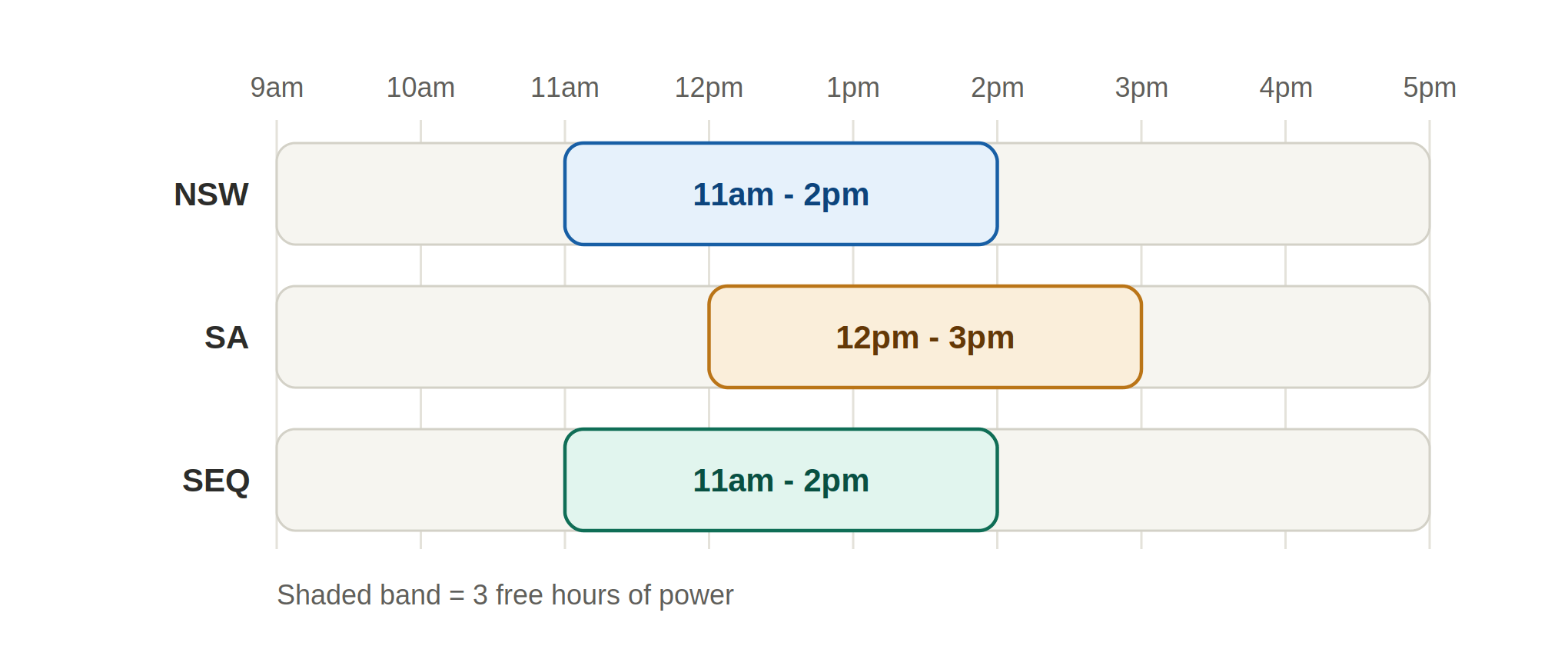
- NSW: 11am – 2pm
- SA: 12pm – 3pm
- SEQ: 11am – 2pm
Victoria Will Soon Have Its Own 3 Hours Free Program
Victoria is about to release its own version, called the “Midday Power Saver.” As Victoria operates outside the default market offer (DMO) system, the rule doesn’t automatically apply there. Victoria is releasing these free daytime plans on 1 October 2026, with the free power window running between 11am and 2pm daily. Retailers in Victoria with 1,000 customers or more must make a Midday Power Saver plan available to customers.
What Is the Solar Sharer Offer, Actually?

The Solar Sharer Offer (SSO) is a rule created by the Federal Government that was launched on July 1, 2026.
The rule forces every retailer with more than 1,000 customers in DMO areas in the covered regions (NSW, SA, SEQ) to put at least one plan on the market that gives consumers a free power window in the middle of the day.
So as a customer, you can choose whether you want to be on a SSO plan.
You’re not forced onto it.
The SSO’s free window of power lands in the middle of the day for a reason.
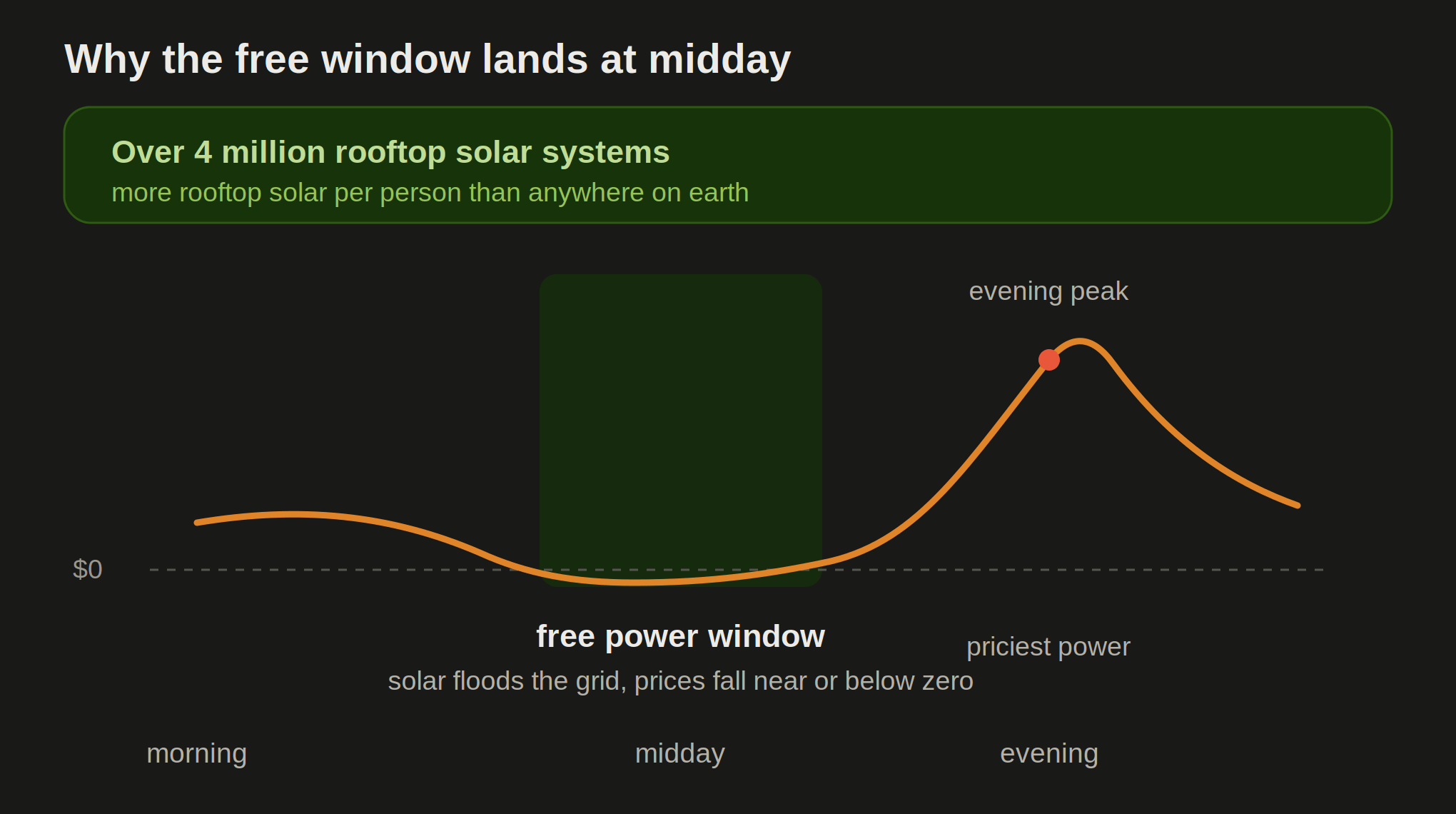
Australia has more rooftop solar per person than anywhere in the world, with over four million solar systems installed. Around midday, all those panels flood the grid with more power than people can use, so wholesale prices fall very low and often go negative.
In plain terms, there is a glut of cheap daytime power going to waste.
The scheme's goal is to hand that surplus to households, nudge people to run appliances when power is abundant, take pressure off the expensive evening peak, and share the benefits of the solar boom with people who do not own panels.
Who Is Most Likely to Benefit?
- Those working from home or with hybrid work
- Households with flexible schedules
- EV owners
- Households with a battery
What the Headlines Leave Out
Retailers do not give away free electricity out of kindness. The cost of the free power window gets clawed back somewhere else on the bill. In practice that means two things to watch:
- Higher daily supply (connection) charges. This is the fixed fee you pay every day no matter how little power you use. Some retailers raised it by more than 85% for the upcoming year, in 2027. This happened even though the underlying usage benchmark went down, which is why the ACCC and the energy regulator are now investigating.
- Higher peak usage rates. The power you draw in the evening, when you most need it, can cost more on an SSO-style plan.
So “free power” is real, but it is not a gift. Whether you come out ahead depends entirely on whether you can use enough power during the free electricity window to outweigh the higher fixed and peak costs.
How to Opt Into an SSO Plan
Two setup steps apply no matter who you are:
- Check if you have a smart meter. SSO plans bill by time of day, which needs a smart meter. If you do not have one, ask your retailer. A national rollout aims to reach everyone by late 2030, but if you request an early upgrade you may have to pay for the install.
- Opt in. You will not be moved onto a free-window plan automatically. You have to choose it and make the switch. Before you do, it’s important that you run the comparisons below to make sure it’s a plan that will really benefit you.
How the Solar Sharer Offer Affects You
So… is a Solar Sharer Offer plan worth it? The answer is really dependent on the current situation with your energy: when you use power, your current energy plan, and your solar situation.
Below we’ve split this guide around the last three situations:
No Solar
If you do not have solar yet, and you are watching your bills
Does it affect you? Yes, and you are exactly who the scheme was designed to include. You do not need panels or a battery to opt in and get the free hours.
How you benefit: Move your big, schedulable jobs into the free window. Dishwasher, washing machine, bulk cooking, EV or e-bike charging, hot water, pre-cooling or pre-heating the house. A single dishwasher cycle a day run for free instead of at a 35c peak rate saves roughly $128 a year, and that is just one appliance.
Note: Hot water systems and pool pumps may not be shiftable if they are on a controlled-load tariff, so check your current setup first.
What to do:
- Confirm the smart meter, then opt in.
- Use appliance timers or scheduling if you are out during the day.
- Before switching, compare your effective cost per kWh, not the “free” headline.
What to watch in the fine print:
- The free window is only useful if you can actually use power between roughly 11am and 2pm. If you are out on weekdays, the benefit shrinks to whatever you can put on a timer.
- Check the daily supply charge and the peak rate before you commit. A big fixed charge can wipe out the savings from the free hours.
How it could backfire: Switching on the “free power” promise alone, then discovering the higher daily charge and peak rates leave you paying more than your old plan.
Thinking of buying solar? The scheme slightly weakens the case for panels alone, because you can now get cheap or free daytime power without owning any. The clear signal across the coverage is that panels-plus-battery is the setup that wins under the new rules. If you invest, plan for a battery rather than treating panels as the finish line.
Solar Only
If you have solar panels but no battery
Does it affect you? Yes, and unfortunately you are the one most at risk of ending up worse off. You already get free or near-free power from your own roof during the day, so a midday free window adds little, while the plan’s higher fixed and peak costs still apply to you.
How you benefit: Modestly, and only if you are home during the day to run appliances live while the sun is up. Without a battery you cannot store the free midday power for the evening, so there is no overnight payoff.
What to do:
- Compare carefully rather than assuming an SSO plan helps you.
- Prioritise a plan with a decent daytime feed-in tariff (what you are paid to export), because exporting is your only way to monetise surplus without storage.
What to watch in the fine print:
- Daytime wholesale spot prices can and do go negative, but residential feed-in tariffs have fallen substantially. Household feed-in tariffs are generally positive or zero depending on the retailer and plan. They're not as lucrative as they once were, but still a real source of income if you're exporting surplus power.
- A high feed-in tariff paired with a bloated daily charge can still be a bad deal. Read the daily supply charge and the evening peak rate first.
How it could backfire: Trading away a good feed-in tariff and picking up an 85%-higher daily charge, all for a free window you cannot store and may barely use. Your realistic options are to stay on a plan with a reasonable feed-in tariff, or to consider adding a battery, which changes the picture entirely (see the next section).
Solar and Battery Storage
If you have both solar panels and a battery
Does it affect you? Yes, and you are the clear winner. The play is simple to describe: charge your battery for free at midday, have it full by early afternoon, then run your home off it through the expensive evening peak.
How you benefit: You sidestep peak grid prices most nights. On cloudy or winter days when your panels cannot fill the battery, you top up cheaply from the grid during the free window instead. If you regularly have spare battery capacity at night, you can go further and sell stored power into a premium evening feed-in tariff, which some retailers price as high as 45c/kWh. Charge cheap by day, sell high at night.
What to do:
- Configure your battery to charge during the free window. This does not happen automatically. See the walkthrough below.
- Shop for the plan with the lowest fixed daily charge that still lets you top up cheaply and does not punish you on the odd evening you need grid power.
- If you have spare evening capacity, chase a premium evening feed-in tariff on top.
What to watch in the fine print:
- You are not immune to the supply-charge hikes. A high daily charge erodes the gains from free charging, so read that line closely.
- Mind the 24 kWh daily free cap, especially if you also charge an EV. EV owners are the most likely to blow past it.
- Some batteries run their own logic. A Tesla, for example, forecasts tomorrow's weather and may skip the cheap window if it expects a sunny day.
How it could backfire: Mostly through inertia. If you do not reconfigure the battery and re-shop your plan, you can end up paying the higher daily charge without capturing the free-charging benefit that justifies it. That is the worst of both worlds.
However, solar batteries are required to be connected to a solar PV system to take advantage of government incentives and rebates.
Tip #1: Planning Your Appliance Use Around the Free Power Window
The principle is “shift the heavy loads into the free hours.” These appliances are good candidates, because they use a lot of power or run on a schedule:
- Dishwasher and washing machine. Most have a delay-start timer which you can set to run inside the window.
- Hot water. Heat pump and electric systems often have a built-in timer. Heating water during the free window and letting the tank hold it is an easy saving.
- EV or e-bike. Charging in the free window instead of at the evening peak is one of the biggest single savings available.
- Heating and cooling. Pre-cool or pre-heat a well-insulated home during the window using a split-system timer. Skip this if your home is draughty or uninsulated, because it will not hold the temperature and you will waste the power. A few dollars of draught-proofing pays off here, since heating and cooling are around 40% of a typical home’s energy use.
Safety note: think twice before running a clothes dryer or similar unattended while you are out.
Tip #2: Setting Up a Battery Around the Free Window
Your battery will not use the free window until you tell it to. Out of the box it has no idea the window exists. The effort ranges from two taps to a genuine fight, depending on the brand. Here is the shape of it, using three common systems as examples.
Tesla Powerwall 3, via the Tesla app (easiest to set up, most stubborn to command)
Set Operational Mode to Time-Based Control, then set your Utility Rate Plan so it knows when the free window is. Usually a couple of minutes. The catch: rather than taking a direct “charge from the grid now” command, Powerwall optimises around your rate plan and its own solar forecast, so it may skip the cheap window if it expects a sunny tomorrow. The upside is that the app is genuinely excellent for everything else, with live solar, battery and home usage tracking and clean energy-mode control all in one place. If in doubt, confirm the current steps in the Tesla app or with your installer, since Tesla updates the app regularly.
AlphaESS range (B3 Plus, T10, Smile-13.3), via AlphaCloud (most detailed settings, worst-hidden)
AlphaCloud gives you 24/7 tracking, historical data and fully customisable charge and discharge schedules, which is exactly what you want here. The trouble is the menu often buries those controls somewhere unintuitive rather than anywhere obvious. Once you find it, set a charge window covering the free hours, add discharge windows for the rest of the day so your AlphaESS battery actually gives its charge back, and confirm charge-from-grid is switched on.
Sigenergy SigenStor, via MySigen (tech-forward)
MySigen leans on AI-driven insights and customisable modes like self-consumption and time-of-use, so setting up the free window is a matter of picking the right mode and defining your window. Worth a close look if you have an EV or plan to get one, since the SigenStor folds solar, battery and EV charging into one system, and the daily free cap is easiest to blow past when a car is charging.
Fox ESS and Growatt (value picks)
Fox Cloud offers customisable work modes and remote configuration, and Growatt’s ShinePhone covers the basics. On both, the job is the same: create a charge window across the free hours, set discharge windows for the rest of the day, and make sure charge-from-grid is enabled.
Three rules that apply to any battery:
- The friendliest app might be the one that second-guesses you.
- The most capable might hide a trap that only bites later.
- Some settings sit behind an installer login, or a grid-charge permission set when the system was commissioned, so you may not be able to finish without your installer.
If you can, do it today, not on the afternoon your free plan starts.
What to Look For in Any Plan (SSO or Not)
You do not have to be on an SSO plan to benefit from cheap daytime power. A well-chosen time-of-use plan can serve you just as well, because your battery or appliances do not care whether the cheap midday power is labelled “free” or just “very cheap.” What matters is the total. Read these lines, roughly in this order:
- Daily supply charge. The fixed daily fee. This is now the decisive number. A rough guide is to look for one closer to $1 than $2 a day.
- Usage rates and structure. Flat (same rate all day) versus time-of-use (peak, shoulder, off-peak, plus sometimes a controlled-load rate). A low off-peak rate can hide a punishing peak rate, so check the peak first, because that is your real exposure.
- Feed-in tariff. What you are paid to export. Daytime rates are now small. A premium evening feed-in tariff matters most to battery owners with spare capacity at night.
- The extras. Green-offset fees, membership or account fees, expiring intro rates, conditional pay-on-time or direct-debit discounts, and any lock-in or exit terms.
Where to Put Your Attention, Depending on Your Setup
- No solar: Lowest daily charge, then usage rate. If you cannot shift usage into the day, a simple low flat tariff is often safer than a time-of-use plan.
- Solar, no battery: Best daytime feed-in tariff, then daily charge, then evening peak rate.
- Solar and battery: Lowest daily charge, then a tolerable evening peak rate, then the best evening feed-in tariff you can get on top. Also confirm the plan actually permits grid charging of your battery.
If you don’t know where to start, retailers currently offering SSO plans include AGL, Energy Australia, Red Energy and Origin — compare their Solar Sharer plans directly with your current one before switching.
One More Habit for Everyone Who Wants to Save on Their Energy Bill
Re-shop at least once a year. Retailers release new plans annually and often leave existing customers on stale, worse offers — a so-called loyalty tax. A plan that was good two years ago may not be now.
The Bottom Line
The more storage you have, the more this scheme rewards you, but the reward is never passive.
- No solar yet: Easy to opt in and benefit if you are home during the day. If you plan to invest, aim for panels plus a battery, not panels alone.
- Solar, no battery: Be cautious. You may be one careless switch away from a worse deal. Protect a decent feed-in tariff, or consider adding a battery.
- Solar and battery: You win, but only after you configure the battery and re-shop for the lowest daily charge.
Whatever your situation, the honest comparison is always the same: what are you paying per kWh across everything you use, once every fee and rate is counted. Chase that number, not the word “free.”
Your Journey to Zero Bills
Here’s the honest takeaway from all of this: an SSO plan can genuinely work in your favour, but it isn’t automatically the right call for everyone. The biggest wins tend to go to people with a battery ready to soak up that free midday power and carry it through the pricey evening peak. For others, those higher daily charges and peak rates can quietly leave you worse off than where you started. That’s where we come in — batteries are what we know inside out, including exactly how they stack up under these new rules, and we’ll tell you straight whether one’s worth it for your home or not.
This is a general explainer, not financial advice. Plan details, rates and eligibility change, so check the fine print with your retailer and model any plan against your own usage before switching.