


Latest Reductions on the Federal Battery Rebate Explained
The Federal Battery Rebate is being restructured into a tiered system that will taper incentives for larger batteries and be effective from May 1, 2026.
What this means is that batteries over 14kWh will receive less small-scale technology certificates (STCs) per kilowatt upfront on an installation.
Federal Energy Minister, Chris Bowen, announced these significant changes to the home battery rebate at a press conference on Monday, 13 December, aimed to ensure the sustainability of the program after its massive uptake has threatened to bleed the pool dry mid next year.
“163,016. That’s how many Australian households have put in a battery since 1 July,” Mr Bowen said.
“Over the last six months we've been managing the program, talking to the industry, and today I'm also announcing adjustments going forward to make sure the program continues to be fair and sustainable. And we've done this in close consultation with the industry.”
Let’s get more into what this means for you…
Why do STCs matter for the National Battery Rebate?
The federal battery rebate, called the ‘Cheaper Home Batteries Program,’ is being delivered through the Small-scale Renewable Energy Scheme (SRES) which creates STCs for eligible new installations of clean energy technologies.
It is through this structuring that the federal battery rebate designates the rebate amount that clean energy customers are entitled to.
This is how the tiers will work:
Batteries up to 14 kWh (inclusive) STC will apply to 100%
Every kWh over 14 and up to 28 kWh (inclusive) STC will apply to 60%
Every kWh over 28 and up to 50 kWh (inclusive) STC will apply to 15%
There will be other changes to the Cheaper Home Batteries Program which we cover here:
These changes include an additional $5bn in funding.
Batteries Will Drop in STC Value Twice As Fast
That is not all that will change when it comes to declining STC value for Australia’s national battery rebates.
Initially the home battery rebate dropped annually, in line with all other technology on the SRES list.
Now the STC factor for home battery rebates will drop down twice a year: in January and July.
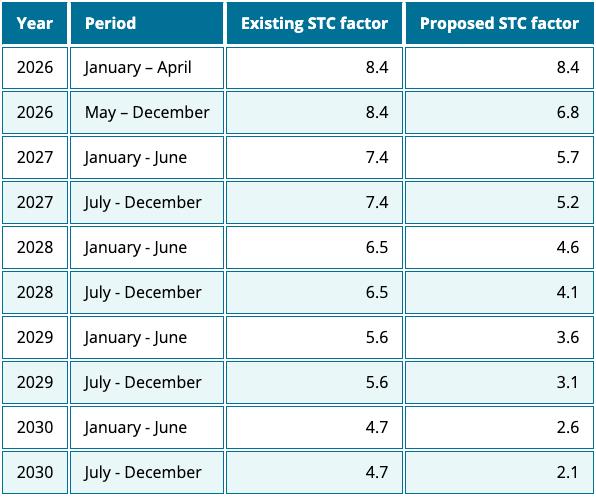
Source: DCCEEW
It’s Time to Ask Yourself… Would You Benefit More From a Bigger Battery?
A bigger battery isn’t for everyone, but it offers lots of great benefits and makes the most sense for some users.
Benefits of a bigger solar battery:
More energy independence
More self-consumption capacity
- Longer backup power
Greater future proofing for new energy needs
Great fit for bigger solar batteries:
Households with EV cars and EV car charging stations
Households with electric hot water system (or heat pump), air conditioning, and heating
Households with a pool pump
Households with 5 or more people
If you would benefit the most from a bigger solar battery (over 14kWh) it's worth making an installation a priority now.
As long as you get your solar battery installed before May 1, 2026, you will be able to take advantage of the highest home battery rebates available next year.
Every solar battery installed from May 1, 2026 will be subject to these new home battery rebate changes--and bigger batteries will be affected the most.
Solar Battery Group is Australia’s largest solar battery installer. We’re 100% Australian owned and operated, bringing with us over 30 years industry experience and CEC approved solar products.
Get in your big battery installation before Next May and maximise your solar storage.