
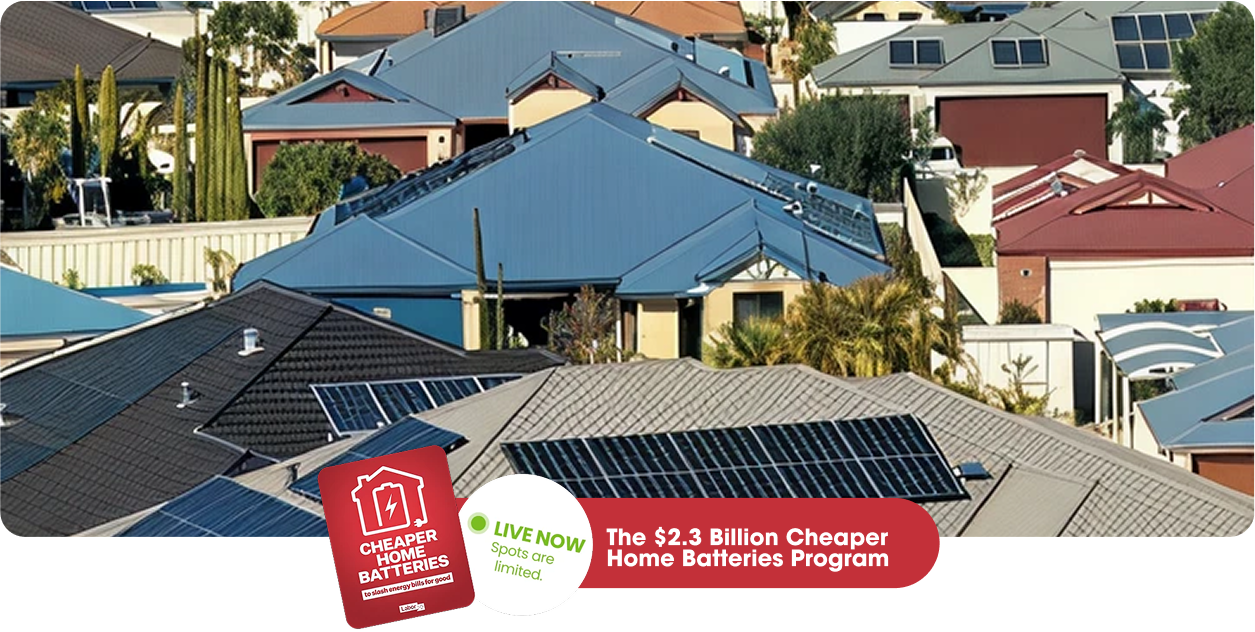
With power bills on the rise, yet again, and blackouts becoming a common occurrence - it’s no surprise that more Queenslanders are rethinking how they power their homes. That’s why thousands of Queenslanders are now turning to solar battery storage - and thanks to the Queensland Solar Battery Rebate 2025, it’s more affordable than ever.
Whether you’re looking to cut down your power bill, reduce your reliance on the grid, add more value to your property, or finally take the plunge into renewable energy, here’s everything you need to know.
But first,
What Is the Cheaper Home Battery Scheme?
Kicking off on 1 July 2025, the Cheaper Home Battery Scheme is a federal government solar rebate designed to make solar battery storage accessible for more Australians.
- 10 million Australians are eligible
- 4 million households already have solar
- There are no restrictions on who can apply
The goal? To help households store solar energy during the day and use it when they need it most - at night, during blackouts, or when demand is high.
Wondering about eligibility for the solar rebate in Queensland? You can learn more, check your eligibility and enter Solar Battery Group’s priority queue here: National Battery Rebate Program.
Call 1300 223 224Request a quote
Queensland Solar Battery Rebate 2025: What Does It Actually Cover?
While the Cheaper Home Battery Scheme is a federal program, it is tied into the broader Queensland solar rebate scheme, providing residents with even more support.
Under the rebate:
- Eligible households receive a subsidy for battery installation
- No need to install new solar if you already have panels
- Works alongside other solar power rebates in Queensland
Unfortunately, QBEST rebates have now closed - but this new initiative fills that gap with generous financial support.
Projected Savings in QLD: What Can You Expect?
Let’s talk numbers.
According to the 2024 Queensland Household Energy Survey, the average annual electricity bill in SEQ ranges from $1,500 to $2,000 per year.
These rising costs are being reflected in the Australian Energy Regulator’s Default Market Offer (DMO), which sets a benchmark electricity price for households in South East Queensland. The DMO has increased again in 2025, highlighting the growing pressure on electricity bills - even for those on basic standing offers.
By adding a solar battery, families can potentially reduce their energy costs by up to 70%, depending on usage and the system size.
Call 1300 223 224Request a quote
Example Personas (Based on typical Queensland usage)
- Family of 4 in Brisbane: ~$2,000 annual bill → could save up to ~$1,400
- Retired couple in Townsville: ~$1,200 annual bill → potential savings of ~$800
- Single renter in Cairns (with landlord-installed solar): ~$900 bill → estimated savings up to ~$500
Renting? There’s help for you too.
The Supercharged Solar for Renters Program supports landlords in installing solar on rental properties - so tenants can still benefit from solar energy without the upfront costs.
According to the QLD Government, “The Supercharged Solar for Renters Program will assist with tackling the cost of living by providing eligible landlords with rebates of up to $3,500 to install solar photovoltaic (PV) systems on their rental properties, driving down electricity bills for tenants across Queensland.”
It’s a win-win. Learn more here: QLD Government Info
Solar Conditions in QLD: Ideal for Storage
With some of the highest solar irradiation rates in Australia, Queensland is a solar goldmine. Thanks to consistently high sunlight hours year-round, most households are in a prime position to maximise solar generation and battery storage.
According to data from the Global Solar Atlas, much of Queensland receives between 5.0 and 6.5 kWh/m² per day of average global horizontal irradiance (GHI), depending on the region. Here’s how average daily solar exposure looks across a few key locations:
- Brisbane: ~5.2 kWh/m² per day
- Cairns: ~5.5 kWh/m² per day
- Townsville: ~5.7 kWh/m² per day
- Rockhampton: ~5.8 kWh/m² per day
- Mount Isa: ~6.0 kWh/m² per day
- Longreach: ~6.2 kWh/m² per day
From the sunny Gold Coast to regional centres like Roma and Mount Isa, Queensland’s solar conditions are among the best in the country - making it an ideal state for harnessing solar energy and investing in battery storage.
QLD Blackout Statistics
Let’s face it - blackouts are no longer a rarity. Year-on-year stats show increasing outages, especially during summer storms and cyclone season.
According to the 2024 Queensland Household Energy Survey, power outages have risen notably in both regional and metropolitan areas.
- 66% of households in Regional QLD experienced a power outage in the last six months - up from 63% in 2023.
- 51% of households in South-East QLD also reported an outage - a sharp rise from 37% the previous year.
Blackout Hotspots:
While blackouts can happen anywhere, some areas in Queensland are hit more frequently than others. Regions that often experience repeated outages include Far North Queensland (especially during cyclone season), the western suburbs of Brisbane, and parts of the Sunshine Coast hinterland.
Solar batteries provide peace of mind, powering essential appliances even when the grid goes down.
What’s Happening To Feed-In Tariffs?
As of 2025, feed-in tariffs in Queensland are dismal and in constant decline, which means that exporting your excess solar energy earns you less. That’s why solar energy storage is key - you store your power instead of selling it for cents on the dollar.
How Solar Batteries Work With Smart Apps
Modern solar systems are smarter than ever. Systems can connect to an app or Home Energy Management System (HEMS), letting you:
- Monitor battery levels in real time
- Track savings
- Automate energy usage
- Weather-proof your energy with performance alerts
Built for Queensland Weather
From salt mist on the coast to tropical cyclones in the north and hailstorms in the south-east, Queensland weather can be tough on energy systems. That’s why Solar Battery Group offers robust, weather-tested batteries - designed to perform reliably in the state’s most challenging conditions.
Take Charge In Under Five Minutes
Whether you’re a homeowner looking to cut bills or a landlord wanting to increase property value, the Queensland Solar Battery Rebate offers real financial and environmental benefits.
Don’t wait until July 1st to apply, enter our priority rebate queue here. Or:
- Call our team on 1300 223 224
- Request a call back
Explore your options with our Solar Battery Solutions