

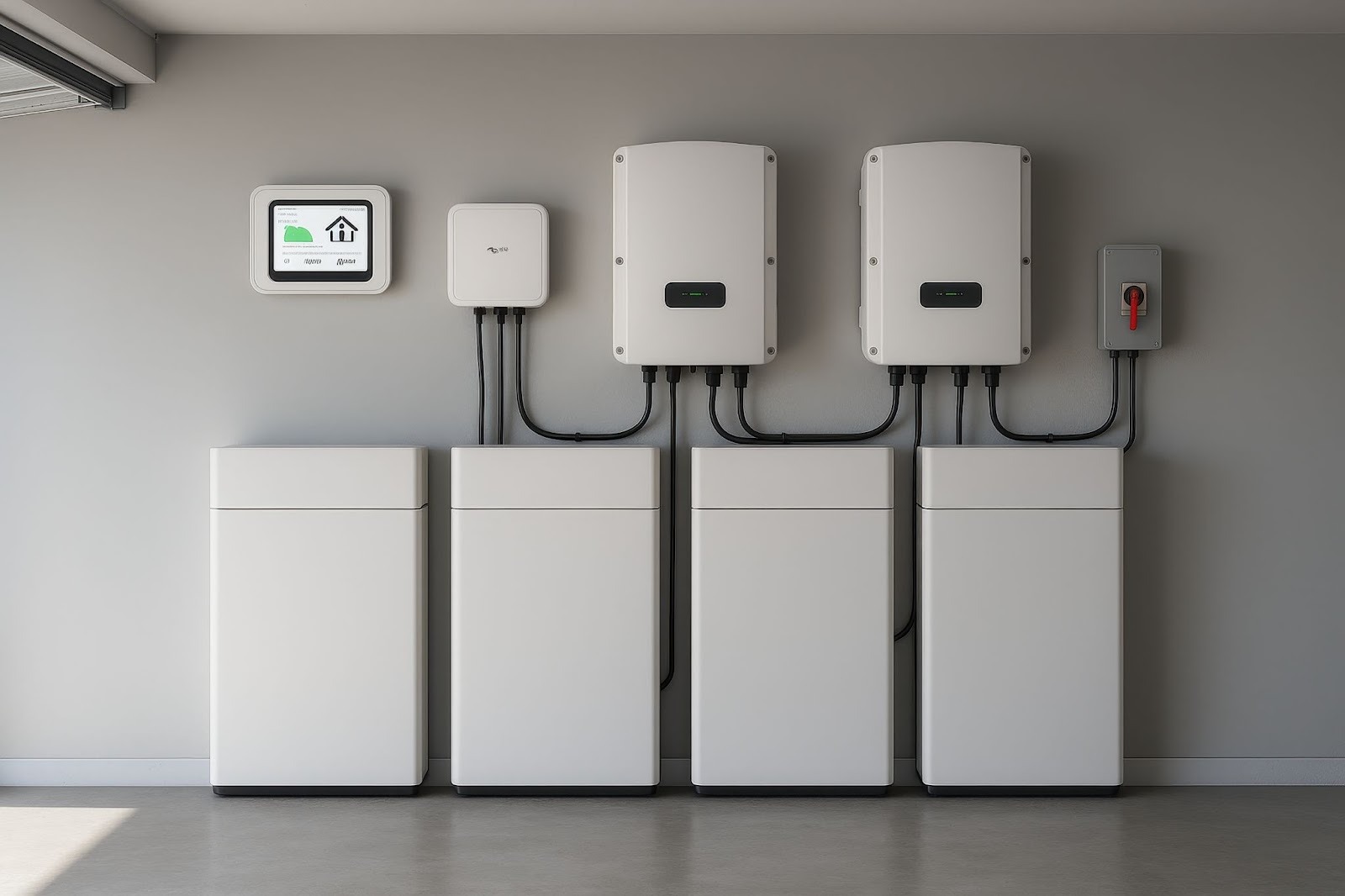
A practical guide to choosing a large solar battery in Australia
You already know you are not a low energy household if you’re looking at 16kWh of solar battery storage. Maybe you have a large family burning through power every evening. Maybe you have an EV - or two. Maybe the air conditioning runs until 10pm and you have quietly accepted that your electricity bill is just a number you try not to look at directly.
Whatever the reason, you are here because you want more from your energy setup. This guide covers what a 16kWh solar battery is, who it genuinely suits, how sizing works in practice, what shapes the price, what to look for before you sign anything, and - importantly - why the federal rebate situation in 2026 makes timing a real factor for buyers at this capacity.
16kW vs 16kWh: what is the difference?
This is one worth clearing up.
A 16kW solar system describes the peak power output of your panels. A 16kWh solar battery describes how much energy it can hold.
Two very different things, measured differently, doing different jobs.
When people search for a "16kW solar battery," they almost always mean a 16kWh storage battery.
The mix-up is everywhere. Now you know - batteries are kWh, panels are kW.
What is a 16kWh solar battery?
It is a serious piece of storage. At 16kWh, you are sitting at the larger end of the residential battery market in Australia - well above what a typical household needs, and squarely in the range that starts making a real difference for high-demand homes.
To frame it practically: most Australian households consume somewhere between 15 and 25kWh per day in total.
A 16kWh battery does not just take the edge off your evening usage - for many homes, it can cover it almost entirely. And if your daily consumption pushes past 25kWh, which it will if you are charging a car overnight or running a heat pump through winter, 16kWh gives you the headroom that a smaller battery simply cannot.
Do You Actually Get the Full 16kWh Out of a 16kWh Solar Battery?
Rarely. And it is worth understanding why before you start comparing specs.
The advertised figure is total nominal capacity. What lands in your home is shaped by a handful of technical realities - none of them deal-breakers, but all worth knowing.
Depth of Discharge (DoD)
This is the big one. DoD tells you what percentage of stored energy is actually accessible in each cycle.
95% DoD You get 15.2kWh usable per cycle (16 × 0.95). A solid figure, and common across quality LFP batteries.
96% DoD Edges up to roughly 15.36kWh usable. The difference sounds minor - and per cycle, it is. Over thousands of cycles, it adds up.
100% DoD Theoretically 16kWh, fully accessed. Less common in practice. Most manufacturers quietly recommend keeping a small reserve to protect longevity and satisfy warranty conditions.
Beyond DoD, round-trip efficiency losses and inverter conversion eat into the practical figure further. A backup reserve - if you want the battery to carry power for outages - will also sit off-limits during normal operation.
The headline number is always going to be optimistic. Comparing usable capacity, not nominal capacity, is the more honest way to shop.
Is a 10–13kW Solar System with a 16kWh Battery the Right Pairing?
For most high-demand households, yes - and the logic is fairly straightforward.A larger solar array generates more daytime surplus. A 16kWh battery gives you somewhere useful to put it. The combination reduces the chance of the battery sitting half-charged on good days and running flat before midnight on heavy-use days.
This pairing tends to work well for:
Households with 5 or more people
EV owners charging overnight - especially with two vehicles
Homes running air conditioning or heating well past sunset
Properties with electric hot water systems, heat pumps, or pool pumps
Anyone whose evening electricity use routinely exceeds 10–12kWh
It also suits households that are not quite there yet but will be soon - the family buying their first EV in the next two years, or the home that is mid-way through electrifying appliances. A 16kWh battery bought now will have more work to do as those changes land, which is often exactly the point.
If your home uses most of its power during business hours and the evenings are quiet, a smaller battery will serve you just as well and cost you less. Size to your actual pattern, not your aspirational one.
Is a 16kWh Solar Battery a Good Fit for Small Businesses?
For the right business, it is a very good fit.The sweet spot is a business that generates strong solar during the day but carries real load into the late afternoon and evening - exactly when grid pricing tends to climb. A 16kWh battery covers that gap more completely than a smaller system, and it does it with enough buffer to handle unexpectedly heavy trading days without running dry before close.
Businesses that often benefit include:
Cafes and restaurants with evening service and constant refrigeration
Gyms and fitness studios running late into the night
Retail stores with extended hours and high air conditioning loads
Medical and dental clinics with energy-intensive equipment
Childcare centres and community facilities
Small offices with server infrastructure running around the clock
Peak Tariff Management
Commercial tariffs are not kind. Demand charges, time-of-use pricing, afternoon peak windows - the billing structure is designed to catch you when consumption spikes. A well-configured 16kWh battery discharges stored solar into exactly those windows, reducing the grid draw that triggers the expensive charges.
Less peak demand. Lower demand charges. Smaller bills. The mechanics are simple; the savings are real.
Reliability When It Counts
For some businesses, a grid outage is not an inconvenience - it is lost revenue, spoiled stock, or a forced closure. A 16kWh system with backup configuration can keep the lights on, the EFTPOS running, and the fridges cold through most short-to-medium grid interruptions.
Self-Consumption Over Export
Many small businesses finish trading before solar generation peaks. Without storage, that surplus disappears to the grid at feed-in rates that have been falling steadily for years. A 16kWh battery captures that surplus and redistributes it across late trading or the following morning - keeping the value inside the business rather than selling it cheap.
Solar Battery Storage Capacity Explained
When it comes to solar batteries, size matters and it's measured in kilowatt-hours, or kWh. That figure represents how much energy a battery can hold at any one time, and getting it right is one of the most important decisions in your solar journey.A good way to picture it is like a water tank on a rural property. Every day, rain fills it up, but what matters is whether the tank is sized right for how your household actually uses water. Too small, and you're running dry by evening, rationing showers and hoping for rain overnight. Too large, and you've spent a fortune on a tank that never gets close to full, sitting there half-empty day after day.
Your solar battery works in exactly the same way. The sun fills it up during the day, and your home draws from it once the panels stop generating. If the capacity is too small, it could run dry well before sunrise, pushing you back onto the grid overnight, which is precisely what you were hoping to avoid. Too large, and you're investing in storage that your household may never consistently fill, meaning that money could have been better spent elsewhere.
The goal is a battery that fits your home's rhythm: one that captures what your solar panels generate during the day and reliably carries you through to the next morning. It's less about chasing the biggest number on the spec sheet and more about understanding your own energy habits and finding the size that genuinely matches them.
The 20 Percent Rule for Solar
Your solar system needs to generate roughly 20 percent more energy than your household consumes. That buffer handles cloudy days, seasonal dips, and the general unpredictability of weather without leaving your battery chronically undercharged.Example: a home consuming 1,000kWh per month should target a solar system producing around 1,200kWh per month.
At 16kWh of storage, this rule matters more, not less. A large battery paired with an undersized solar array is an expensive disappointment, it will rarely charge fully, and the return on investment stretches accordingly.
Before committing to 16kWh of storage, confirm your solar generation can actually support it.
How Much Battery Storage Do You Actually Need?
The honest answer: it depends on what you are trying to achieve.Eliminating the grid entirely is technically possible but financially punishing for most households. The smarter path is to target the expensive evening peak, cover it reliably, and let everything else follow.
Step 1: Know your daily usage
Typical Australian household: roughly 16kWh per day
Larger home with air conditioning, electric hot water, and a pool: 30kWh or more
High-consumption household with one or more EVs: 60kWh or more
Step 2: Estimate your evening load
Evening consumption, say 5pm to midnight, is usually where most residential energy is spent. The heavier your post-sunset load, the more battery you need to cover it without touching the grid.
Step 3: Reserve capacity for backup
If blackout protection matters to you, a portion of the battery's capacity needs to be held in reserve at all times. That reserve is unavailable for daily use, which means your effective evening coverage is smaller than the battery's total capacity suggests.
The Sizing Rule of Thumb
Minimum battery storage = 25% of daily usage + 2kWh backup buffer.
For a household using 24kWh per day, that formula returns 8kWh as an absolute floor. But 8kWh covers the peak, not the evening. To cover most of the night, maintain a usable backup reserve, and absorb some variation in daily demand,16kWh starts to make a well-supported case.
For households at 28kWh daily or above, it is often the natural starting point rather than a stretch.
Comparing different 16kWh solar battery options
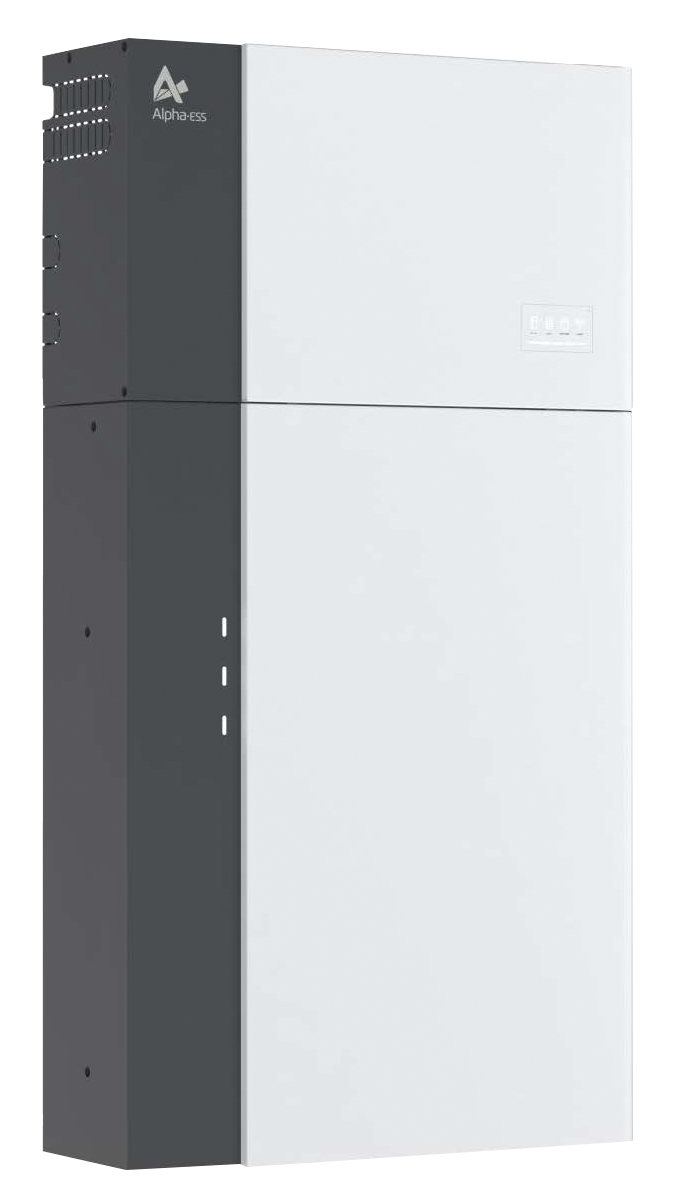
Alpha ESS Smile G3-S5 (2 modules)
16.4kWh
The Alpha ESS Smile G3 S5 is a hybrid solar battery system built for Australian homes that want smarter, more direct control over their energy. Unlike AC-coupled batteries that sit alongside your inverter, the G3 S5 integrates directly with your solar panels through a built-in hybrid inverter - managing solar generation, storage, and home power supply in one cohesive system. Starting at 8.2 kWh per module and expandable up to 49.2 kWh, a two-module setup gives you 16.4 kWh of storage with 7.8 kWh usable per module at 95% depth of discharge. The 5 kW continuous output handles multiple appliances running simultaneously with ease, while dual MPPT inputs accept up to 10,000 W of solar input, meaning your panels can charge the battery quickly and efficiently throughout the day. A 97.3% inverter efficiency rating ensures minimal energy is lost in the process, and the built-in UPS function switches to battery power seamlessly during a blackout.
The Smile G3 residential series has expandable modules in 3.8kWh, 8.2kWh and 10.1kWh; named S3.6, S5 and B6 respectively.
*Please note that enabling blackout protection is an opt-in service, with additional cost.
5 Years Product Warranty
10 Years Battery Performance Warranty (backed by Munich Re)
Get a Free QuoteAlpha ESS Smile B3 (6 modules)
17.2kWh
Deciphered request to enhance product description details
A compact, modular solar battery starting at 2.9 kWh and expandable up to 17.4 kWh, the Smile B3 delivers 3 kW of continuous power to cover your everyday essentials: fridge, lights, Wi-Fi, and more. Its 96% depth of discharge means you get the most out of every kilowatt-hour stored, while seamless UPS backup switches to battery power in milliseconds during a blackout. Built with safe LFP chemistry, rated IP65 for outdoor use, and backed by a 10-year performance warranty through Munich Re, it's a reliable, space-efficient storage solution for households looking to cut evening grid reliance without breaking the budget.
*Please note that enabling blackout protection is an opt-in service, with additional cost.
5 Years Product Warranty
10 Years Battery Performance Warranty (backed by Munich Re)
What is the Expected 16kWh Solar Battery Price in Australia?
Installed, a quality 16kWh battery system will generally land somewhere in the range of $12,000 to $20,000 or more before incentives are applied.After the latest Government rebate, the expected price range has gone down to $8,500 to $16,000.
That range shifts depending on:
Whether this is a retrofit onto an existing system or part of a new installation
Whether your existing inverter is compatible or needs replacing
Switchboard upgrades and compliance requirements
Backup configuration: a full home backup setup costs more than a critical loads setup
Site specifics: access, location, complexity
When comparing quotes, the battery capacity figure is not the whole story. Two quotes at 16kWh can look very different once you account for what is, and is not, included.
How the Federal Rebate Works for a 16kWh Battery
This is where 16kWh buyers need to pay close attention - because the rebate structure from May 1, 2026 treats your capacity differently to a 14kWh system.The Cheaper Home Batteries Program delivers its discount through Small-scale Technology Certificates (STCs). From May 2026, the number of STCs a battery earns will be determined by a tiered structure based on capacity:
- 0 to 14kWh (inclusive):
STC Factor applied at 100%
- Every kWh from 14 to 28kWh (inclusive):
STC Factor applied at 60%
- Every kWh from 28 to 50kWh (inclusive):
STC Factor applied at 15%
For a 16kWh battery, this means your rebate is calculated across two tiers. The first 14kWh receives the full STC Factor at 100%, but the remaining 2kWh above that threshold only attracts STCs at 60% of the Factor. It is a relatively small penalty - only two kilowatt-hours are affected - but it is worth understanding before you compare quotes.
A 16kWh system still captures the vast majority of its rebate at the full rate, which means the extra capacity can still make strong financial sense for households that genuinely need it, particularly EV owners, larger families, and homes with high evening energy use.
The STC Factor Is Also Dropping Twice as Fast
That is not the only change. Previously, the STC Factor declined once a year. From May 2026, it drops every six months, January and July, and at a steeper rate than before.For a 16kWh battery, timing your installation matters more than it does for a 14kWh system.
From May 2026:
The STC Factor is projected to fall from 8.4 to 6.8
The top 2kWh of a 16kWh system will only earn STCs at 60% of the applicable factor
Installing before May 1, 2026 means the full 16kWh system is eligible at the pre-change rate of 8.4, with no tapering applied.
The applicable STC Factor is typically determined by the installation date-not when a contract is signed or a deposit is paid.
On 13 December 2025, the government announced an expansion of the Cheaper Home Batteries Program from approximately $2.3 billion to $7.2 billion over four years, targeting more than two million installations by 2030. The updated structure is aimed at maintaining a discount of around 30% across different battery sizes.
For 16kWh systems, the rebate remains meaningful-but installing before May 1, 2026 allows buyers to avoid both the lower STC Factor and the reduced rate applied to the final 2kWh.
Related:
What to Look For in a 16kWh Battery System
The fundamentals first. Always.
Battery chemistry: Most quality home batteries now use LFP (lithium iron phosphate). It has a strong safety profile, handles deep and frequent cycling well, and tends to age more gracefully than older lithium chemistries. At 16kWh, where the battery is working hard every day, chemistry is not a trivial consideration.
Depth of discharge: Already covered - but worth repeating as a shopping filter. Compare usable capacity, not nominal. A 16kWh battery with 90% DoD delivers less real-world value than one with 96% DoD, regardless of what the spec sheet headline says.
Round trip efficiency: Energy in versus energy out. Some is always lost in conversion. Higher round-trip efficiency means more of what your solar system generates actually reaches your appliances. Over a decade of daily cycling, that gap compounds.
Warranty details: Ten years on performance is the benchmark. Read what is actually guaranteed - the percentage of original capacity the manufacturer commits to at year ten, and what happens if the battery falls short. Compensation terms vary enormously between brands.
Backup capability: Not all 16kWh systems include backup as standard. Some treat it as an add-on. Others require additional switchboard work or a separate gateway device. Know what is in scope before you accept a quote.
CEC approval and installer accreditation: Non-negotiable. The battery must be approved by the Clean Energy Council. Your installer must be accredited by Solar Accreditation Australia. Both matter for rebate eligibility and for the safety of the installation.
Expandability: If there is any chance you will want more storage in three or five years - a second EV, an extension, a business that keeps growing - ask specifically about modular expansion. What are the limits? What is compatible? What does it actually cost to add a module later?
Why Size Can Matter More Than Brand
Brand is not irrelevant. But it is secondary to whether the battery is the right size for what you need it to do.A well-sized battery from a solid Tier 1 manufacturer will outperform a premium brand that is too small to cover your evening load. Every time. The right capacity means:
More consistent evening coverage
Less grid draw during peak pricing windows
Higher self-consumption rates when feed-in tariffs are low
Genuine backup capability without eating into daily usable storage
A system that grows with your energy needs rather than against them
Get the size right first. Then choose the brand.
Is a 16kWh Solar Battery Right for You?
For the right household or business - yes, without a doubt.If you use significant power after sunset, if you have an EV or are about to, if your daily consumption sits at 24kWh or above, or if energy independence is a genuine priority rather than an aspirational nice-to-have, 16kWh is not oversized. It is appropriate.
The caveat: this decision should be based on your actual usage data, not national averages. Smart meter data is your best starting point. An experienced installer who will look at your numbers, not just your suburb, is the second step.
And given the rebate changes landing May 1, 2026, the third step is not to sit on it too long.
Why Solar Battery Group
Solar Battery Group is Australia's largest solar battery installer, operating nationwide. We install CEC approved products, and our team works from your real usage data, not assumptions, to recommend the right capacity for your home or business.For a tailored recommendation on a 16kWh solar battery, request a callback or call the team directly on 1300 223 224.